
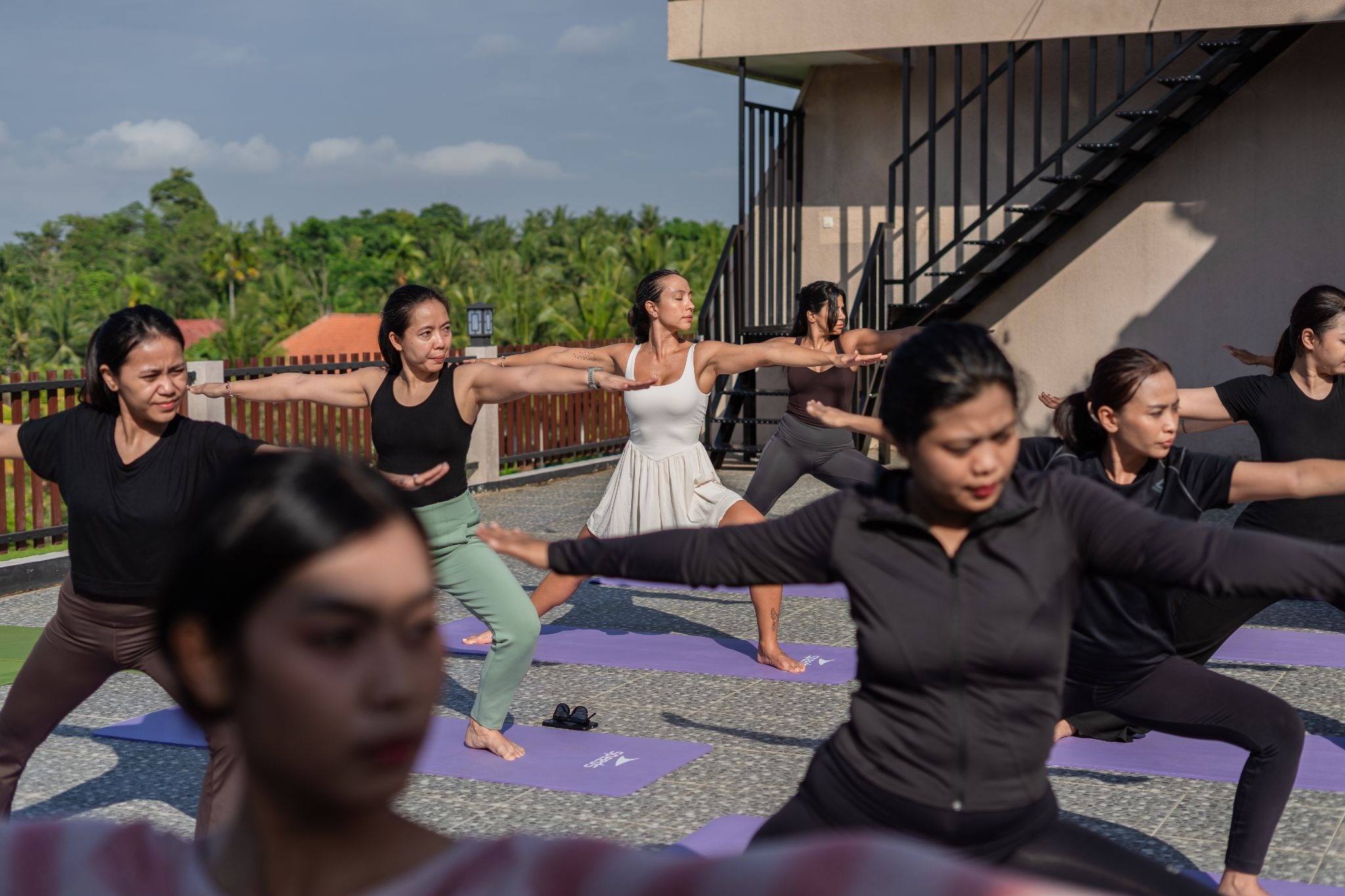
Looking for yoga in Bali? Here’s the thing: you don’t have to be a hardcore yogi to belong on the mat. You just need a reason to slow down.
Maybe your reason is burnout.
Maybe it’s the endless notifications.
Maybe you’ve been working remotely for months and suddenly realised that your body has spent more time in a chair than anywhere else.
Or maybe you simply want to wake up somewhere beautiful, breathe a little deeper, stretch your body, and start the day without immediately reaching for your phone.
Whatever brought you here, Bali – and especially Ubud – has become one of the world’s most recognisable destinations for yoga, wellness, and mindful travel.
And honestly? It makes sense.
Why Is Yoga Becoming Such a Big Part of Travel?
Travel used to be about ticking places off a bucket list.
Now, increasingly, it is about how you feel while you are there.
Wellness tourism has become a significant part of the global travel economy. According to the Global Wellness Institute, wellness travellers took approximately 1.24 billion wellness trips in 2024, with wellness travel accounting for 8.3% of all tourism trips and 17.6% of tourism spending. Asia-Pacific has also emerged as the world’s largest region by number of wellness trips.
And the trend is moving beyond traditional spa holidays.
Today’s wellness traveller is looking for experiences that combine:
- Yoga and movement
- Meditation and breathwork
- Nature
- Better sleep
- Mental wellbeing
- Healthy food
- Spiritual experiences
- Community
- Digital detox
- Meaningful, slower travel
The Global Wellness Institute’s 2026 trends even highlight “The Nervous System Reset,” “Deep Rest,” “Destination-Scale Wellness,” and “The Luxury of Privacy” – a pretty good reflection of what modern travellers are searching for: less rushing, more resetting.
In other words, wellness is no longer just something you squeeze into a holiday.
For many travellers, wellness is the holiday.
So… When Is the Best Time to Do Yoga?
There is no single “perfect” time to practise yoga. The best time is ultimately the time you can practise consistently and comfortably.
But if you’re travelling in Bali, different times of day can create very different experiences.
Morning Yoga: Start Before the World Gets Loud
For many people, morning is the sweet spot.
The air tends to feel fresher, the surroundings are quieter, and your mind hasn’t yet been filled with emails, meetings, and notifications.
A morning yoga session can be a beautiful way to begin a day in Ubud — especially when you’re surrounded by greenery, rice fields, tropical gardens, and the slower rhythm of Balinese life.
Try:
6:00-8:00 AM
Perfect for gentle Hatha, Vinyasa, mobility work, meditation, or a more energising flow.
And yes, there is something slightly magical about doing your first downward dog of the day while Bali is still waking up.
Midday Yoga: Slow Down Between Adventures
Travelling doesn’t mean every hour needs to be productive.
If you’ve spent the morning exploring Ubud’s cafés, temples, markets, or rice terraces, a midday practice can become your reset button.
Try a gentler session around:
11:00 AM-2:00 PM
Think Yin Yoga, restorative yoga, stretching, breathwork, or meditation rather than an intense practice – particularly in Bali’s tropical climate.
Late Afternoon & Evening Yoga: Unplug & Exhale
This is another beautiful option, especially if your goal is relaxation.
A slower evening practice can help you transition from “travel mode” to “I’m actually on holiday” mode.
Try:
4:00-7:00 PM
Perfect for Yin, restorative yoga, gentle flow, meditation, or breathwork.
Just avoid practising immediately after a heavy meal. Give your body some time to digest first.
Who Is Yoga Actually For?
Plot twist:
Yoga is not only for flexible people.
You don’t need to touch your toes.
You don’t need expensive leggings.
You don’t need to know what Sanskrit pose names mean.
And you definitely don’t need to be able to fold yourself into a human pretzel.
Yoga can be adapted to different ages, fitness levels, and experience levels. That’s one of the reasons it works so well within wellness travel.
Beginners
If you’ve never tried yoga before, Bali can actually be a great place to start.
Look for beginner-friendly classes, Hatha Yoga, gentle flow, restorative yoga, or introductory sessions.
Remote Workers & Digital Nomads
Spending eight hours a day on a laptop?
Yoga can become a much-needed movement break from your work routine.
This is especially relevant for digital nomads staying in Ubud, where the combination of co-working, co-living, wellness and community fits naturally into a longer stay.
Active Travellers
For runners, cyclists, surfers, hikers and fitness enthusiasts, yoga can complement other physical activities through mobility, stretching, balance, and mindful movement.
Wellness Travellers
If your idea of a good holiday involves meditation, healthy living, nature, spa treatments, slow mornings and getting your nervous system to finally chill out — welcome to the club.
Long-Stay Travellers
Yoga becomes even more meaningful when it becomes part of your daily lifestyle rather than a one-off holiday activity.
And that’s exactly where long-stay wellness travel in Bali gets interesting.
But Wait – Becoming a Yoga Instructor Isn’t as Easy as It Looks
Instagram can make yoga teaching look deceptively simple.
Beautiful studio.
Morning sunlight.
Perfect leggings.
A group of people moving in sync.
Cute Bali backdrop.
Done, right?
Not quite.
Being a professional yoga instructor requires much more than being flexible or knowing a few poses.
A responsible yoga teacher needs to develop knowledge and skills around areas such as:
- Yoga philosophy and principles
- Anatomy and physiology
- Alignment and movement
- Sequencing
- Breathwork
- Meditation
- Teaching methodology
- Verbal cueing
- Class management
- Modifications and adaptations
- Understanding different student abilities
- Safety and injury awareness
- Professional and ethical responsibilities
And perhaps most importantly:
You need your own practice.
Teaching someone how to move safely requires far more awareness than simply demonstrating a pose.
A good instructor isn’t necessarily the person who can perform the most impressive handstand.
It is often the person who can look at a room full of different bodies and abilities and create a practice where everyone feels safe, supported, and included.
That is a completely different skill set.
Bali & the Rise of Yoga Tourism
Yoga has a particularly interesting relationship with Bali.
Over the years, yoga has become deeply connected with Bali’s international wellness and tourism identity, particularly in destinations such as Ubud, Seminyak, and Canggu.
Academic research published by Universitas Udayana in 2025 examined how yoga in Bali has transformed through global tourism, including changes in its practices, management, symbols, and relationship with international travellers.
At the same time, Bali’s tourism industry continues to see wellness, spiritual experiences and yoga as important travel trends, with Ubud and other village-based destinations positioned to benefit from the growing demand.
And this is where things get particularly interesting for travellers.
Yoga tourism in Bali is no longer simply about booking a yoga class.
It can be an entire lifestyle experience.
You can wake up and practise yoga.
Have breakfast somewhere surrounded by greenery.
Work remotely for a few hours.
Take a walk through the rice fields.
Visit a Balinese temple.
Try a meditation or sound-healing session.
Enjoy a massage.
Meet other travellers.
Then end the day with a slow dinner.
The destination becomes part of the practice.
Why Ubud Is One of the Best Places for Yoga in Bali
If Bali is the wellness destination, Ubud is arguably one of its strongest wellness hubs.
Surrounded by rice terraces, tropical greenery, rivers, cultural sites, art communities and wellness spaces, Ubud offers a very different rhythm from Bali’s southern beach destinations.
Research into foreign tourists’ preferences has also identified a diverse wellness ecosystem in Ubud, including yoga retreats, meditation retreats, spiritual retreats, detox programmes and spa experiences.
And the appeal isn’t only for experienced yogis.
Ubud works beautifully for travellers who want to combine:
Yoga + Nature + Culture + Wellness + Remote Work + Slow Living
That combination is particularly relevant to today’s younger travellers.
Research published in 2026 on Gen Z demand for nature-based and wellness tourism in Ubud highlights the growing importance of personal, wellbeing-oriented travel experiences and the role of social media in shaping this demand.
So yes, your “I just want to disappear to Bali for a month and figure my life out” era has a destination.
It’s called Ubud.
Where to Stay in Ubud If Yoga Is Part of Your Lifestyle?
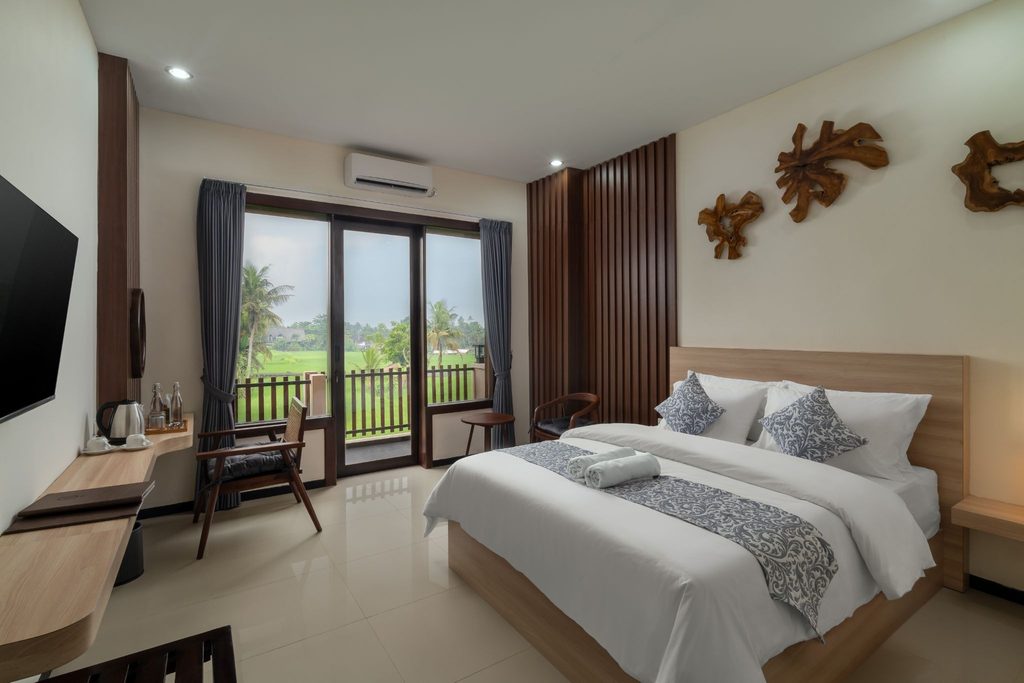
This is where choosing accommodation becomes important.
A hotel can be perfect for a short escape.
But if you’re staying for several weeks, your needs start to change.
You need somewhere you can:
Sleep well.
Work comfortably.
Meet people.
Take a break.
Practice your routines.
And actually feel at home.
That’s where co-living in Ubud becomes an interesting option.
Instead of treating Ubud as somewhere you visit for three days, you can experience it as somewhere you temporarily live.
And for travellers combining yoga, wellness and remote work, Sembari Co-Working & Co-Living Ubud offers a lifestyle that fits naturally into that rhythm.
Meet Sembari: A More Comfortable Way to Experience Ubud
Located in Ubud, Sembari Co-Working & Co-Living is designed for people who want more than simply a bed for the night.
It’s a place where living, working and connecting can exist in the same space.
Imagine this: Wake up, take your time, do your yoga practice, have coffee, open your laptop, get some work done, take a break, meet people, explore Ubud, come home.
Repeat – but without the feeling that you’re constantly rushing from one hotel to another.
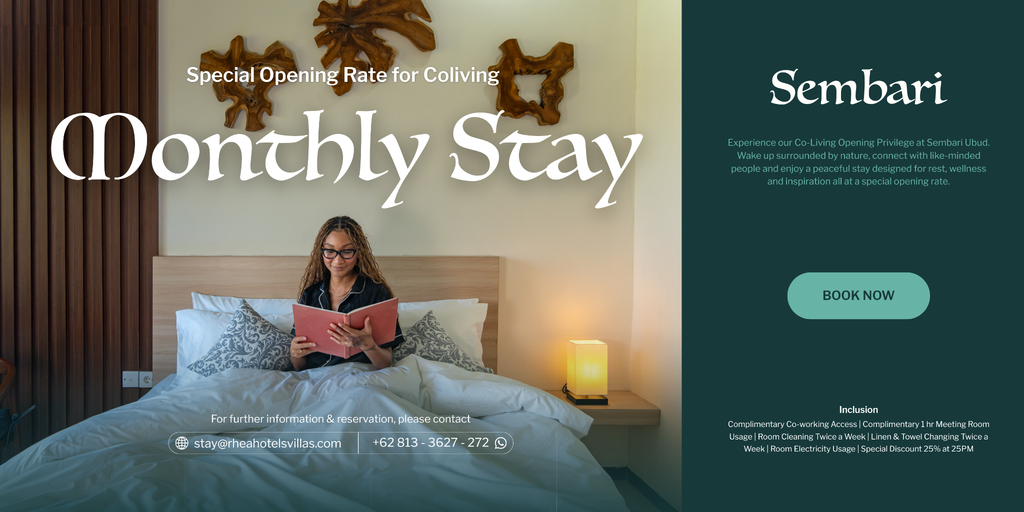
For travellers planning a monthly stay in Ubud, Sembari currently offers a Special Opening Rate for Monthly Stay, with additional inclusions designed to make long-term living more convenient.
Your Monthly Stay Includes:
- Complimentary co-working access
- Complimentary 1-hour meeting room usage
- Room cleaning twice a week
- Linen & towel changing twice a week
- Room electricity usage
- Special 25% discount at 25PM
The idea is simple:
Stay longer. Live slower. Work comfortably. Make Ubud part of your lifestyle.
Your Bali Yoga Era Doesn’t Have to End After One Class
Maybe you’re coming to Bali for yoga.
Maybe you’re coming for wellness.
Maybe you’re a digital nomad looking for a better work-life rhythm.
Maybe you’re simply tired of living life at 100 km/h.
Whatever your reason, you don’t have to turn your Bali experience into another checklist.
You can slow down.
Move your body.
Breathe.
Work when you need to.
Rest when you don’t.
Meet people.
Explore Ubud.
And give yourself enough time to actually experience the place.
Because perhaps the real luxury of wellness travel isn’t doing more.
It’s finally having enough time to do less.
And if you’re looking for a place to stay in Ubud where co-living, co-working, wellness and slow living can come together, Sembari might just be the place to start.
Ready to Stay a Little Longer?
Special Opening Rate for Monthly Stay at Sembari Co-Working & Co-Living Ubud. Sembari – Stay. Work. Connect. Slow Down.